
Authenticity in the Age of Equestrian Influence
As equestrian imagery becomes increasingly visible in fashion and celebrity culture, the industry faces a distinction between those who borrow the aesthetic of horses and those whose influence is built from within the sport.
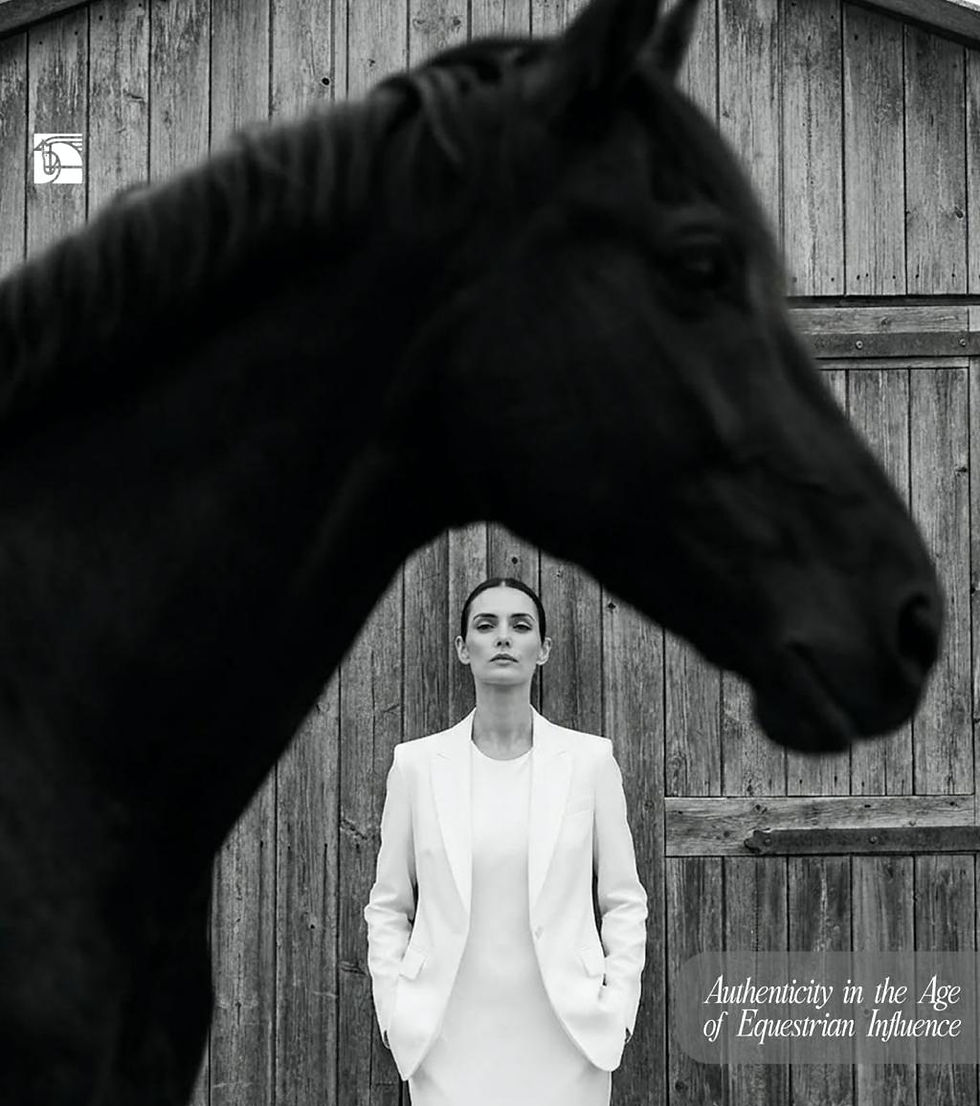
By Aleksandra Spasic
Published May 8, 2026
Equestrianism has always carried cultural weight beyond the arena. Its visual language of elegance, tradition, and the athletic partnership between horse and rider has long appealed to fashion and luxury branding. But as celebrities and influencers increasingly bring horses into mainstream media, a more complicated question emerges: who is shaping the public image of the sport, and what kind of equestrian identity are they selling?
The answer is not straightforward.
For decades, equestrianism has functioned as both sport and symbol. It represents many different facets such as discipline, wealth, rural identity, athletic partnership, and inherited tradition. These associations make it highly attractive to industries built on image. Fashion in particular has repeatedly drawn from riding culture, whether through show ring styles or the broader language of country and stable life.
In recent years, that relationship has become more visible. Equestrian references now appear not only in fashion editorials, but in celebrity branding, social media content, campaign imagery, and luxury lifestyle positioning. Vogue has written about the connection between fashion and riding, noting that horseback riding has long influenced fashion and that models such as Kendall Jenner and Bella Hadid have genuine equestrian ties.
This creates a layered dynamic. Some public figures are riders first, or at least riders in a meaningful and sustained way. Others use horses primarily as part of a visual language. Many fall somewhere in between. For the equestrian industry, the distinction matters because visibility is not neutral. The way horses are represented shapes public understanding of the sport and the values it is built upon.
Celebrity Riders and the Question of Authenticity
Celebrity equestrianism is often treated with skepticism, but that skepticism can be too simplistic. Some high-profile figures have longstanding and well-documented connections to horses.
Bella Hadid is a particularly complex example. She is one of the world’s most recognizable models, but her relationship with riding is not merely aesthetic. She has spoken about beginning riding at a young age, and her equestrian ambitions were widely reported in connection with the 2016 Olympics before Lyme disease interrupted that path. In 2017, she described having to retire from professional riding before the Olympics as one of the most difficult career decisions she had made.
Hadid’s return to horses in recent years, including her presence in Western and cutting horse contexts, complicates the assumption that celebrity equestrian imagery is automatically inauthentic. In her case, the sport is not simply a borrowed visual identity. It is part of a longer personal narrative.
Kendall Jenner occupies a similarly visible, though differently framed, position. Fashion coverage has repeatedly connected her public image with riding and Western-inspired style. Vogue has described Jenner’s long-standing love of horses and equestrian sports, while coverage of her fashion choices has positioned her within the broader “horse girl” or “ranchcore” aesthetic.
Her 2023 Stella McCartney Winter campaign illustrates the way celebrity, fashion, and equestrian imagery can merge. The campaign featured Jenner atop various horses and was widely discussed in fashion media as an example of horse-girl fashion entering luxury branding. Reports noted both Jenner’s equestrian background and the campaign’s sustainability framing.
These examples show why the issue is not whether celebrities “really ride.” Some do. The more useful question is how their riding is translated for public consumption. Is the horse presented as a partner, an athlete, a cultural symbol, or an aesthetic object?
The answer shapes the message.
When the Horse Becomes a Brand Device
The tension becomes clearer when equestrian imagery is detached from the demands of equestrian practice. To people inside the sport, horses are not props; they are powerful yet sensitive animals whose care is complex. Equestrianism is not simply an image of freedom or elegance. It is also labour, repetition, risk, and often failure.
When mainstream media reduces horses to an aesthetic, it can reinforce a version of equestrianism that is highly polished but incomplete. It highlights the beauty of the sport while obscuring the systems behind it: the service providers, financial barriers, and daily work required to sustain it.
This matters because public understanding increasingly influences the industry. Issues of welfare, accessibility, social licence, and consumer trust are shaped not only by what happens inside the sport, but by how the sport appears from the outside.
Celebrity imagery can bring equestrianism to wider audiences, but it can also distance the public from the reality of horses. If the horse is used primarily as a symbol of luxury the sport risks being understood as aesthetic before responsibility.
Equestrian-First Influence
This is where equestrian-first influencers occupy a different role.
Creators such as Matt Harnacke offer a useful contrast because their platforms are built from within the horse world. Harnacke’s public identity combines modeling, lifestyle, and content creation, but his authority is rooted in riding and equestrian life. His own website describes him as a model, rider, and leading equestrian influencer, while HorseWorldTV, which he co-founded with Jesse Drent, is positioned as an online equestrian network offering content for riders of different ages and abilities.
This pathway reverses the celebrity model. Rather than bringing horses into an already established public identity, equestrian-first creators build public identity through horses. Their influence depends on credibility within the community, not only reach outside it.
That distinction matters for brands. An equestrian-first creator can often translate between the sport and the wider lifestyle market more effectively because they understand both the visual appeal and the lived reality. They can make equestrianism aspirational without stripping it of context.
Harnacke’s positioning reflects this duality. His content exists within the world of polished imagery and lifestyle branding, but it remains anchored in horse ownership, riding, and equestrian storytelling.
For the industry, this kind of influence may be especially valuable. It can broaden the audience without severing the connection to the sport itself.
The Industry’s Visibility Problem
Equestrianism has a visibility problem, but not in the way it is often understood.
The sport is present in fashion, celebrity culture, luxury branding, and country lifestyle aesthetics. What is less visible is the infrastructure that makes it real. The public sees the horse, the outfit, the setting, and the lifestyle. It sees far less of the work, cost, accountability, and expertise behind those images.
This gap creates both opportunity and risk.
For brands, celebrity association can deliver reach. It can make equestrian imagery more culturally relevant and commercially powerful. But if that visibility is not grounded in authenticity, it may do little to build long-term trust with equestrian consumers.
For equestrian-first influencers, the challenge is different. They may not have the same mainstream reach as global celebrities, but they often carry deeper credibility within the audience that understands the sport. Their influence is less about borrowing the aesthetic and more about translating the experience.
The industry needs both forms of visibility, but it should not confuse them.
What Brands Should Understand
For equestrian brands, the question is not simply who has the largest audience. It is who has the right relationship to the audience.
A celebrity campaign may introduce equestrian imagery to millions of people, but an equestrian-first creator may move a smaller audience with far greater trust. One offers scale. The other offers credibility.
The most effective brand strategies may involve understanding where each belongs. Celebrity riders can help bring equestrian culture into broader conversation. Equestrian-first influencers can help preserve the specificity and integrity of that culture.
The mistake is treating all horse-related visibility as equal.
In a market where consumers are increasingly sensitive to authenticity, especially within niche communities, representation matters. Riders know when something feels real. They also know when horses are being used as decoration.
This does not mean every campaign must be solely educational. Equestrianism has always had aesthetic appeal, and there is nothing inherently wrong with that. But when brands use the image of the horse, they also borrow from a culture built on years of inherited knowledge and respect for the animals that it operates around.
That comes with obligations.
Authenticity as Infrastructure
Authenticity is often treated as a branding concept. In the equestrian industry, it functions more like infrastructure. It shapes trust and determines whether an audience sees a campaign as connected to the sport or merely adjacent to it. It also influences whether equestrian consumers feel represented or exploited.
The rise of celebrity equestrian imagery shows that horses remain culturally powerful. On the other hand, the immense popularity of equestrian-first influencers shows demonstrates the demand for voices that understand the sport from within.
The future of equestrian influence will likely sit between these two forces. Mainstream visibility will continue to matter, especially as brands seek broader audiences. But credibility will depend on whether that visibility respects the realities of the horse world.
The question, then, is not whether celebrities belong in equestrian culture. They will always exist in that space. The more pertinent question is whether the industry can distinguish between visibility that merely borrows from horses and visibility that deepens public understanding of the sport.
That distinction will define the next era of equestrian influence.